Vintory AI
Exceptional marketing.
Without the marketing team.
Vintory AI learns your business, then writes and designs the campaigns that go after the owners in your market. Change any line as you read it. Send it with one click.
- No agency, no creative queue, no waiting on a copywriter
- No print broker, sequencer, domains or DNS to set up
- Edit any headline, offer or image and watch it change
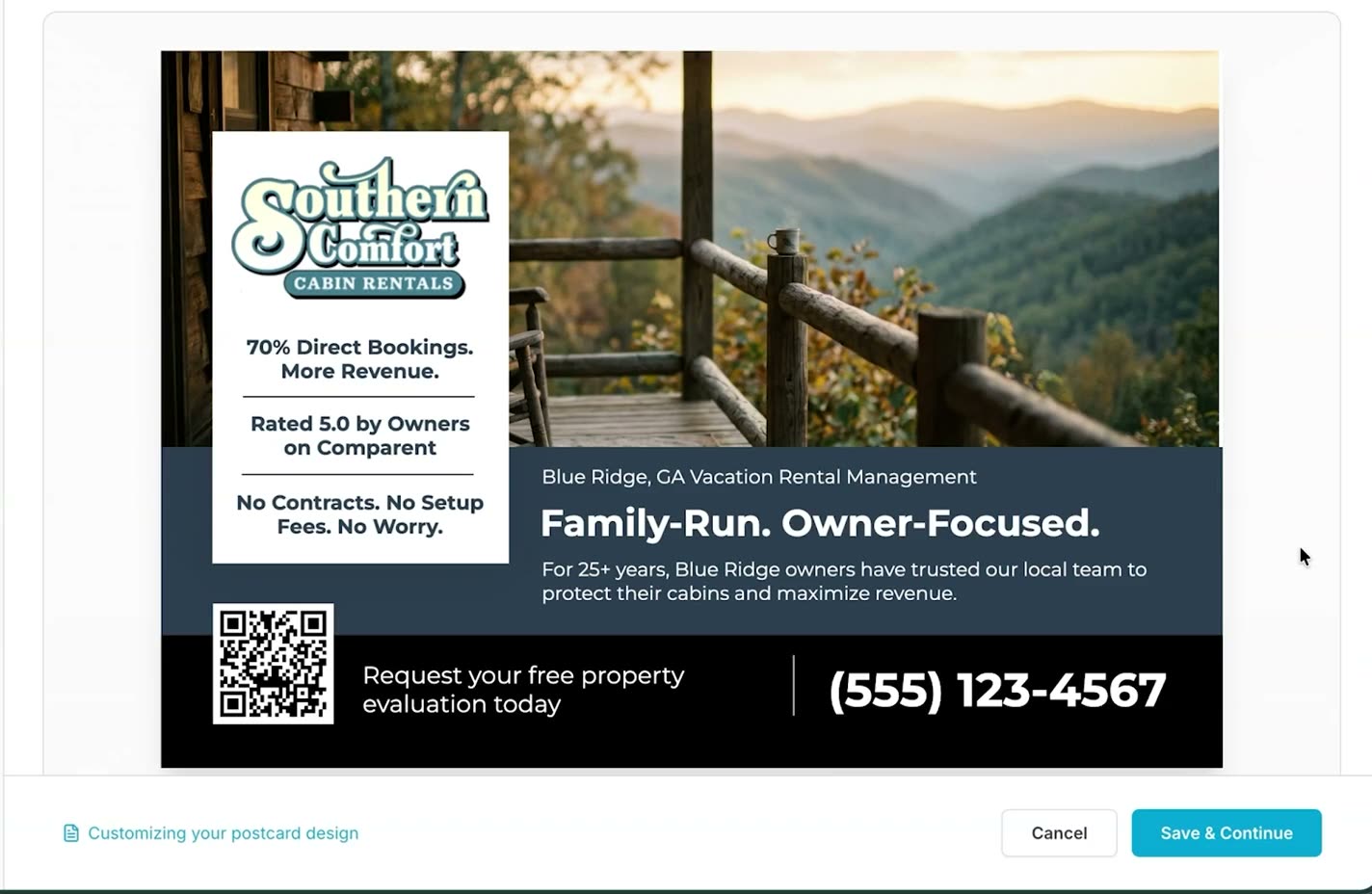
Choosing the angle, then the postcard it writes.
End To End
One URL in. Signed owners out.
Every stage below happens in one place, guided the whole way. Nothing gets handed to an agency, re-keyed into another tool, or parked in someone else’s queue while your season runs down.
Phase One
It learns your business
Before it writes a word it reads everything about you that is already public, then shows you where you stand against the managers an owner would call instead.
We do the homework. You correct us.
Vintory AI reads your site, your listings and the rest of your online footprint, then fills in your brand — voice, services, positioning, audience, colors, logo. You steer and correct what it got wrong instead of filling in a blank form.
What it reads, and what you keep control of
- It starts at your website and works outward — service pages, listings, the way you already describe yourself to owners and to guests.
- Every field it fills is editable. You almost certainly know something about your market that is written down nowhere online, and this is where it goes.
- This profile is the source everything downstream is generated from, so a correction here fixes the copy in every postcard and email that follows.

See yourself the way an owner sees you.
A brand score, a read on your market, and a ranked list of what to fix first — measured against the managers a homeowner is actually choosing between. If you are not ready to market yet, it says so and tells you why.
Why a score, and why it can tell you not to spend
- An owner deciding who manages their home is not evaluating you in isolation. They are weighing you against two or three alternatives, so the report grades what you offer against what those alternatives offer.
- The output is a punch list: the specific gaps that make you the second-best option in your own market, ordered by what to fix first.
- If the fundamentals are not there yet, it will tell you to fix them before you spend on mail. Marketing a weak offer harder only buys a more expensive no.

Phase Two
It finds the homes you want
Not every absentee address. The homes you would actually take into your program, and the people who own them.
Build the wishlist. Then get the owner.
Draw your boundary and filter down to the homes you would actually take — size, type, value, and how the property is being used today. Then pull the owner behind each one: name, mailing address, email, phone.
Why an absentee list is the expensive way to do this
- An absentee or non-owner-occupied record tells you one thing: the owner lives elsewhere. That same list holds long-term rentals, second homes nobody rents out, and houses somebody is quietly flipping.
- We read listing sites, permit and registration records, and the rest of the public short-term-rental trail, so a home already earning as a vacation rental is marked as one.
- That cuts both ways. You stop paying to mail thousands of homes that were never candidates, and you catch active rentals an absentee filter alone would have missed.
- A home already operating as a short-term rental has proven its owner wants the income. That is a warmer conversation than talking someone into trying it.

The data you bought is already in the campaign.
Records you pull in PIPER arrive inside Vintory AI as targetable lists — no CSV round trip, no re-uploading, no drift between what you paid for and who you mail. Slice them by how the home is listed, what it is worth, or who manages it today.
What the extra signals let you say
- Because each record carries the listing and management detail behind it, a list can be as specific as owners already signed with a national brand, or owners running the place themselves on Airbnb.
- Those two owners need opposite messages. One is being underserved by somebody else. The other is doing all the work alone.
- It is the detail behind the records, not the row count, that makes this possible — and it is the difference between one generic mailer and four that each land.

Phase Three
It builds the campaign, you edit it live
Ideas, postcards, email sequences and landing pages, all built from the same profile. Change any line and it changes as you type. No ticket, no copywriter, no waiting.
Angles built from your position, not a swipe file.
It knows your business from intake and how you stack up from the report, so every idea it proposes is a way to put your specific advantage in front of an owner — with the persuasion framework behind it shown. Have your own angle? Describe it and it builds the campaign around yours.
Where the ideas come from
- Ideas are generated against established persuasion and direct-response frameworks, not a folder of postcards that happened to work for somebody else in another market.
- Each one shows the framework it is built on, so you can judge whether the argument fits your market instead of guessing at why it was suggested.
- You have expertise the software does not. When you already know the angle, the custom path takes it in your words and builds the campaign around it.

Postcards that look designed, not generated.
Pick a proven layout and it fills in copy and imagery drawn from your brand and your market, then you rewrite any line of it on the spot, manually or with AI. Printing, postage and addressing are handled, so approving the piece is the last thing you do.
Why it does not look like everyone else's mail
- The layout is a proven structure, not a filled-in template. The copy inside it is written against your brand profile and your market, so two managers who pick the same layout do not end up with the same postcard.
- Nothing is locked. Change a headline, swap the offer, replace the image, and the card updates as you type.
- No print broker, no mail house account, no minimum order to negotiate. Approve the piece and it goes out.

Cold email that reads like a person wrote it.
Short, plain, and written to earn a reply in about ten seconds — not a newsletter that announces itself as marketing in the preview pane. Domains, DNS, warm-up and sending pace are handled for you, so it reaches the inbox without putting your main domain at risk.
Cold email is hard. Here is what has to go right
- Nothing matters unless the email hits the inbox and the owner sees it. Sending cold outreach from your primary domain risks the reputation you depend on for guest and owner mail, and pushing it through a tool built for opt-in newsletters is a good way to get shut off. Separate domains, DNS records, warm-up and pacing are set up and run for you.
- It has to survive a two-second glance. Owners have heuristics, and a long subject line, a company name in the from field, a wall of text, images and newsletter styling all read as marketing before a single word is processed.
- So these are short and visually plain — shaped like an email one person sends another, not like a designed broadcast.
- It has to be about them. The instinct is to introduce your company. What earns a reply is being obviously useful to that owner in the first line.
- It is written for the reply, not the click. Replying is the path of least resistance, it converts better than sending someone off to a form, and replies are one of the strongest signals for staying in the inbox.
- The whole cadence is written at once with spintax variants, so the follow-ups build on the first message instead of restating it.

Pages built to convert, not just to exist.
A branded page live on its own URL in minutes, with a form built around the path of least resistance. If someone starts and drops out, the address they entered is enough to identify the property and follow up.
What the page is doing that a template site is not
- The structure is not invented. It comes from studying what converts on owner-acquisition pages across this industry, and on the best-performing landing pages outside it.
- The block library maps to the arguments you need to make and the layouts owners already know how to read. The page should look like yours without making anyone work out where the information is.
- Forms are built to cut friction rather than collect everything at once, and small gains in conversion compound across every campaign pointing at the page.
- Speed and SEO are built in. A page that loads slowly or fights a phone loses the lead before the pitch is read.

Phase Four
It closes the loop
Replies, scans and form fills land in one place, each tagged with the campaign that earned it.
A CRM with only the parts you will use.
Built for how a VRM actually works: see the lead, see the property, talk to the owner, leave a note. Everything arrives tagged with the campaign that produced it, so attribution is not a reconstruction exercise.
Deliberately not an enterprise CRM
- The failure mode of a general-purpose CRM is fifty fields nobody maintains and a pipeline that stopped reflecting reality in week three.
- This one is visual and property-first, because a VRM thinks in homes and owners rather than in abstract opportunity records.
- AI assistance is being layered on top of it, so the routine follow-up work keeps getting faster.

What each campaign did, and what it cost.
Every mail piece carries a per-recipient QR code and every form is tied to its campaign, so scans, replies and submissions roll up against what you spent. The next drop gets aimed with evidence instead of instinct.

FAQ
Frequently Asked Questions
Ready When You Are
See it run on your own market
Bring your URL. We'll show you the report, the audience, and the campaign it produces.